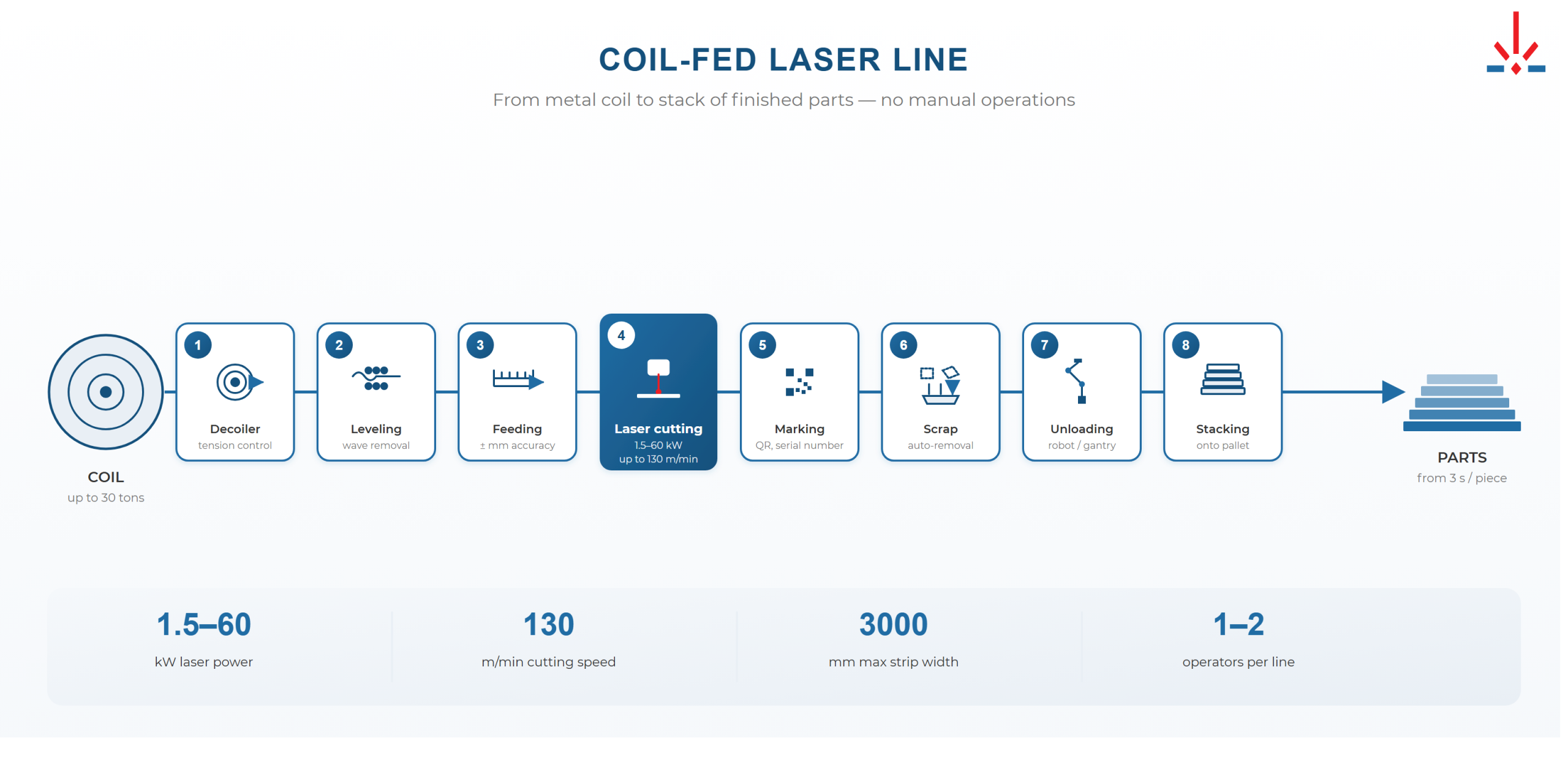
A coil-fed laser cutting line is a fully automated system that transforms a metal coil into a stack of finished blanks — no dies, no manual loading, minimal scrap. Here is a breakdown of every stage, each component, and its role.
The Process in One Paragraph
A coil is loaded onto the decoiler. The strip feeds through a leveler that removes deformations. The flat strip moves onto a conveyor table where the cutting head cuts part contours following a DXF program. The scrap skeleton is trimmed and removed automatically. Finished parts are unloaded and stacked — manually, by gantry, or by robot. The entire cycle is continuous: 1–2 operators, cycle time per part — from 3 seconds.
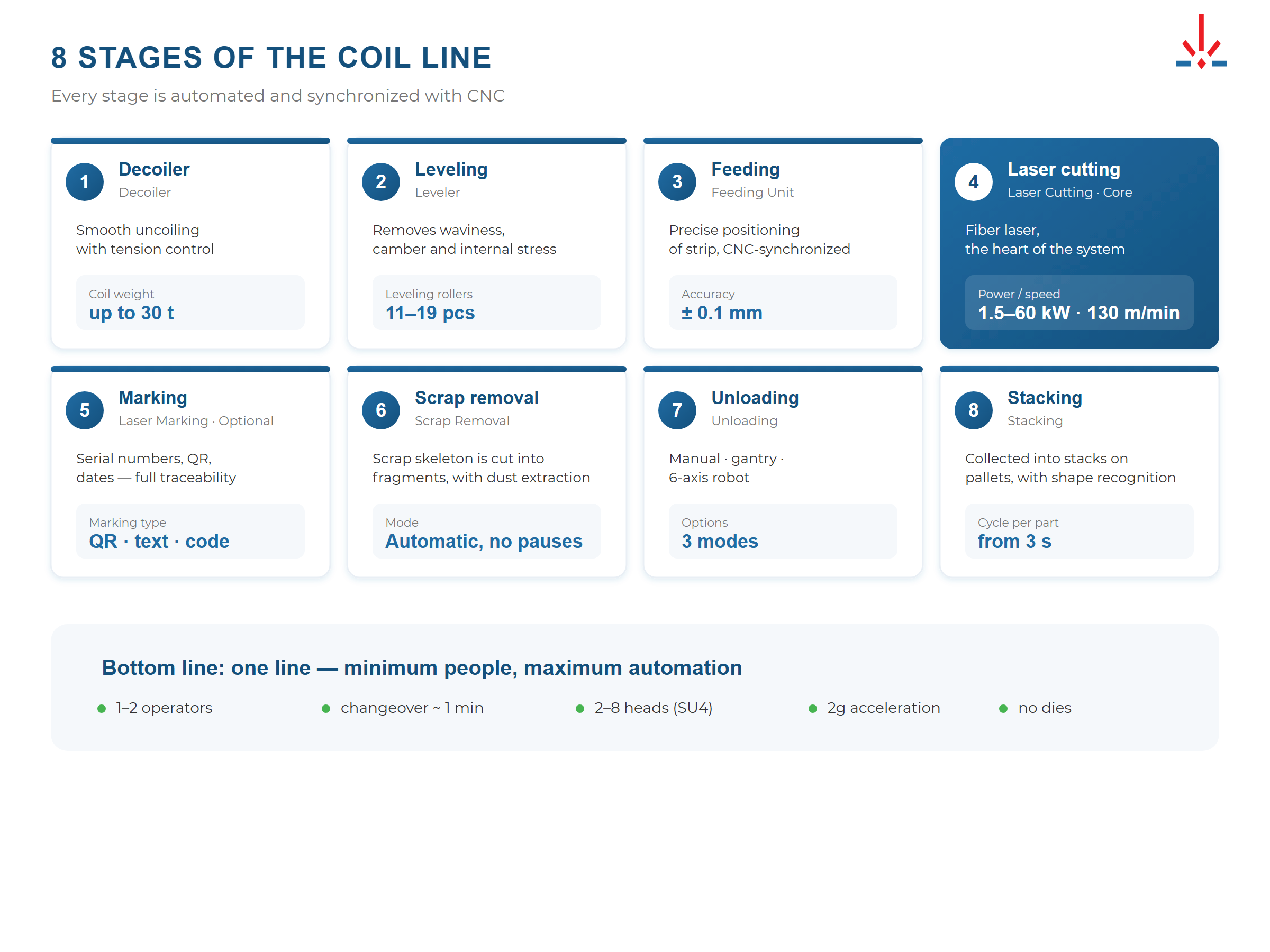
8 Line Components
1. Decoiler
Smooth coil unwinding with strip tension control. Coils weighing up to 35 t are loaded by crane or forklift. The decoiler ensures even feeding without jerks or sag.
Option: multiple decoilers for running different coils without changeover.
2. Leveler / Straightener
Removes strip deformations from coiling: waviness, camber, residual stress. The strip passes through a roller system and exits geometrically flat. Leveling precision is critical — an uneven strip means unstable laser focus and cut defects.
3. Feeding Unit
Precision strip feed onto the conveyor table. Controls speed and positioning to sub-millimeter accuracy. Synchronized with the CNC system: strip feed and cutting head movement are coordinated in real time.
4. Laser Cutting
The core of the line. A fiber laser source generates a beam focused by the cutting head onto the strip surface.
| Parameter | Range (SBMachines lineup) |
|---|---|
| Laser source power | 1.5–60 kW |
| Number of cutting heads | 1–8 |
| Head travel speed | up to 130 m/min |
| Acceleration | 1.2g |
| Cutting gas | Nitrogen, oxygen, compressed air |
The cutting head automatically adjusts focus and gas pressure for the material type and thickness. Cutting takes place on a conveyor table — the strip moves continuously or step-by-step depending on configuration.
Multi-head: the SU4 series features 2–8 cutting heads working in parallel. Two heads deliver approximately 2× throughput on the same parts.
5. Laser Marking (Optional)
Each part receives a unique ID: serial number, QR code, production date. Marking at 20/30/50 W, speed up to 8,000 mm/s. Provides full traceability — critical for automotive and aerospace.
6. Scrap Removal
The strip skeleton (waste after part cutting) is automatically trimmed and removed from the conveyor. The system includes:
- Skeleton cutting into manageable fragments
- Transport to a scrap container
- Fume and particle extraction (Siemens + TORAY filtration)
No manual scrap handling required — the line manages it continuously.
7. Unloading
Three options depending on part geometry and required speed:
| Option | When used |
|---|---|
| Manual unloading | Low volumes, non-standard parts |
| Gantry system | Standard parts, high speed |
| 6-axis robot | Complex shapes, mixed parts in one cycle |
8. Stacking
Automatic collection of finished parts into stacks. The system identifies part shape and orientation, then places them onto pallets. Result: a ready stack of blanks that goes directly to the next step — forming, welding, or shipping.
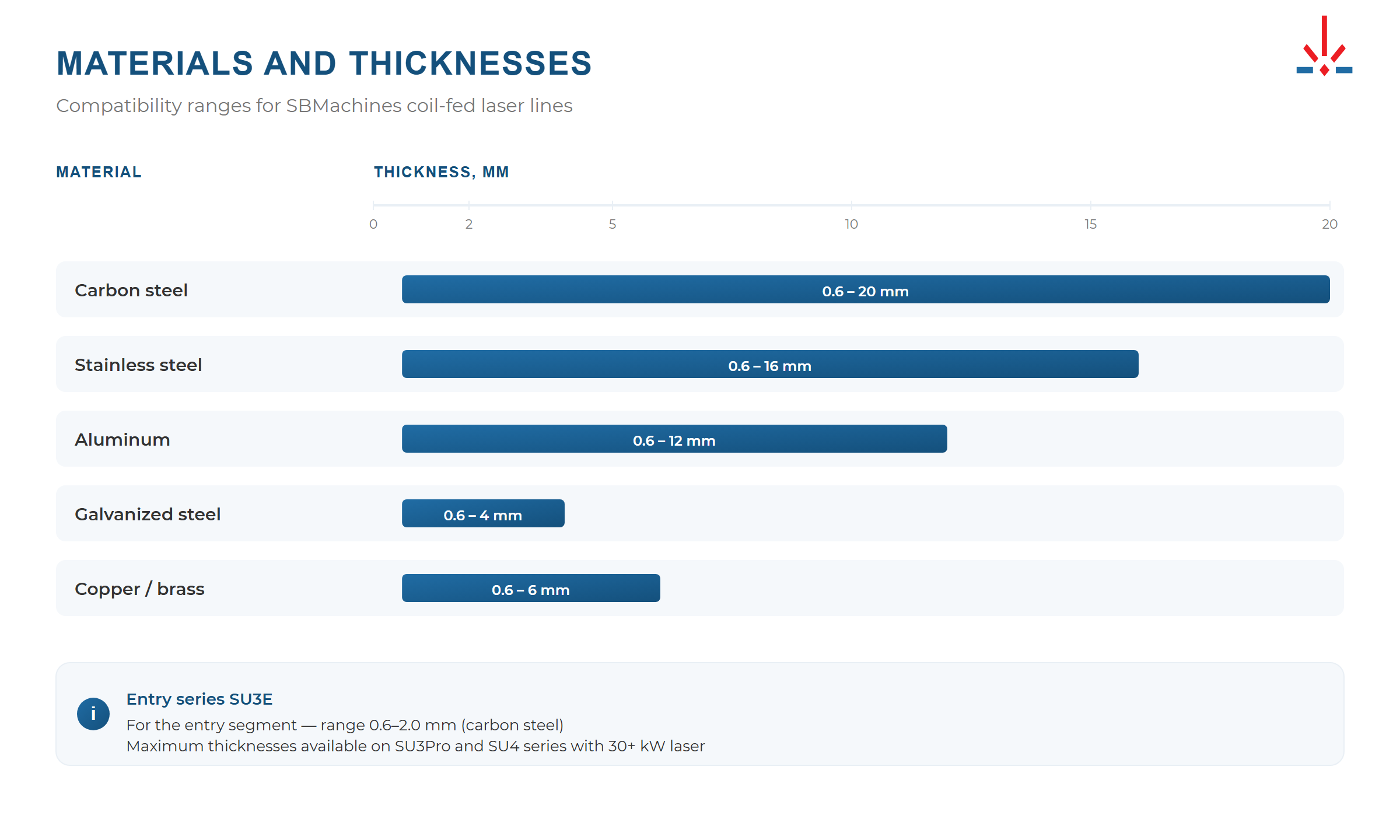
Materials and Thicknesses
| Material | Thickness | Notes |
|---|---|---|
| Carbon steel | 0.6–20 mm | Primary range: 0.8–6 mm |
| Stainless steel | 0.6–20 mm | AISI 304, 316, etc. |
| Aluminum | 0.6–20 mm | Requires nitrogen cutting |
| Galvanized sheet | 0.6–3 mm | Pre-painted steel — no coating damage |
| Advanced high-strength steels (AHSS/UHSS) | 0.6–6 mm | Up to 1,200 MPa, including Usibor/ALSi |
Strip width: up to 1,500 mm (SU3E) or up to 2,150 mm (SU3Pro, SU4).
Ready to Cut Costs and Boost Efficiency?
Automation Options
| Option | Benefit |
|---|---|
| Multi-Gantry Cutting | 2×/3×/4× speed increase with multiple gantries |
| 6-Axis Robot | Stacking of complex-shaped parts |
| Gantry Sorting System | Automatic sorting and stacking |
| Integrated Panel Bending | Bending immediately after cutting — one line instead of two |
| Additional Decoilers | Multiple coils without changeover |
| Filtration & Ventilation | Siemens + TORAY, industrial grade |
| Screw Compressor with Dryer | Compressed air supply for cutting |
Target Industries
Automotive. Body and structural parts, blanks for hot and cold forming. Advanced high-strength steels AHSS/UHSS up to 1,200 MPa. Laser marking ensures traceability for every part.
HVAC & Climate Equipment. Air conditioner housings, heat exchangers, enclosures. Thin metal 0.6–2 mm, high speed, mass production.
Home Appliances. Panels and housings for washing machines, refrigerators, ovens. Galvanized and pre-painted sheet without coating damage.
Cookware. Discs of varying diameters from stainless steel and aluminum. No die needed per size — one DXF per diameter, changeover in one minute.
Commercial Refrigeration. Chambers, insulation panels, display cases. Long parts, pre-painted steel.
Contract Manufacturing. One line serves dozens of customers with different parts. Minimum batch — from 1 piece. The ideal model for metal service centers.
Solar / Energy. Panels, frames, mounting elements. Thin aluminum and galvanized steel.
Heavy Transport. Wheel discs, frame elements. Thick material up to 18–20 mm.
Knives and Cutlery. Blade blanks in several thicknesses and sizes on one line. Blades of one family are nested together on the strip, so a few coil grades cover the whole range.
Silos and Steel Tanks. Roof segments, wall sheets, and auxiliary parts. Large parts are cut from the strip without the length limit of a standard sheet.
Agricultural Machinery. Panels, guards, hoppers, and structural sheet parts from carbon and galvanized steel. Many part numbers in medium volumes, where a die set for each part does not pay back.
EV Battery Enclosures. Tray and cover blanks from aluminum and high-strength steel. A design change goes into production as a new program, with no tooling change.
SBMachines Series
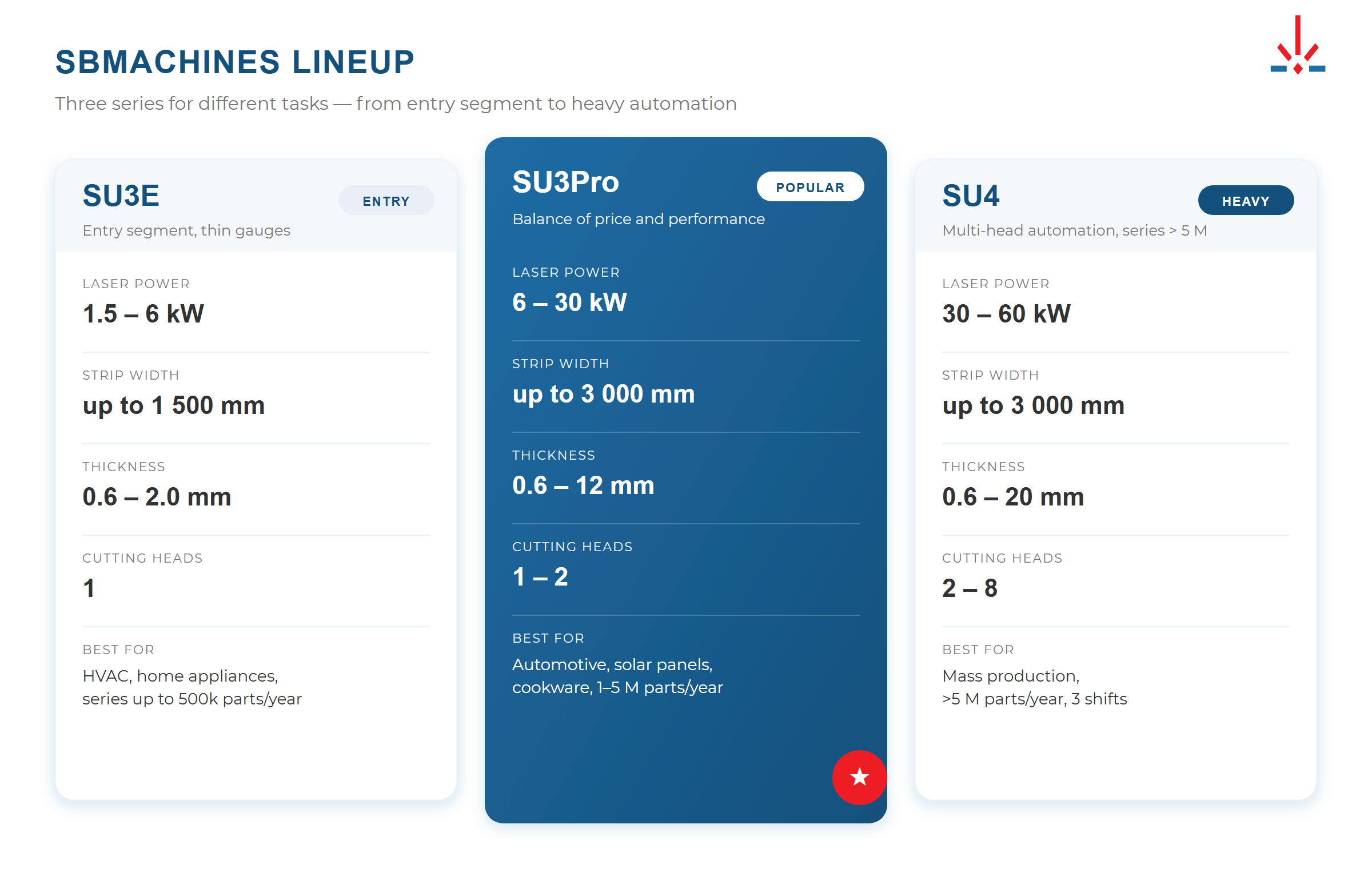
| Series | Positioning | Power | Max. width | Thickness | Heads |
|---|---|---|---|---|---|
| SU3E | Entry Level | 1.5–6 kW | 1,500 mm | 0.6–1.2 mm | 1 |
| SU3Pro | Professional | 3–60 kW | 2,150 mm | 0.6–20 mm | 1 |
| SU4 | Multi-Head | 3–30 kW | 2,150 mm | 0.6–20 mm | 2–8 |
| SU5 | Zero-Waste | 3–12 kW | 2,100 mm | 0.6–3.0 mm | 1 |
FAQ
Q: How does a coil-fed line differ from a sheet laser with an uncoiler?
A: A coil-fed laser line is an integrated system: decoiling, leveling, cutting, scrap removal, and stacking operate as a single unit under one CNC controller. A sheet laser with an uncoiler is two separate devices without end-to-end automation.
Q: Does it require a special foundation?
A: No. The line installs on a flat industrial floor. No loop pit, no dedicated foundation, no overhead cranes required — unlike a press line.
Q: How fast is changeover to a different part?
A: ~1 minute. The operator loads a new DXF file into the CNC system. No mechanical changeover is needed — no dies, no changeable tooling.
Q: Can the line integrate with existing production?
A: Yes. The line output is a stack of finished blanks on a pallet. It connects to any downstream process: forming, bending, welding, painting. The integrated Panel Bending option combines cutting and bending in a single line.
Q: What is the typical delivery and installation timeline?
A: Depends on configuration. Contact SBMachines engineers for a timeline based on your specifications: [email protected]