The laser blanking market is growing at 8.59% CAGR, reaching $936M by 2032 — driven by demand for flexible, die-free manufacturing in automotive, appliance, HVAC, and electronics industries.
Revolutionize Your Blanking with Coil-Fed Laser Systems
Over 90% of blank cost is raw material. Even a 5% reduction in scrap on a busy production line saves up to $1,000,000 per year. Production of high quality parts directly from coils with minimal material loss — material savings of 15–20% vs sheet-fed laser processing, increasing efficiency by up to 400%.
 In stock
SEE THE MACHINE IN GERMANY
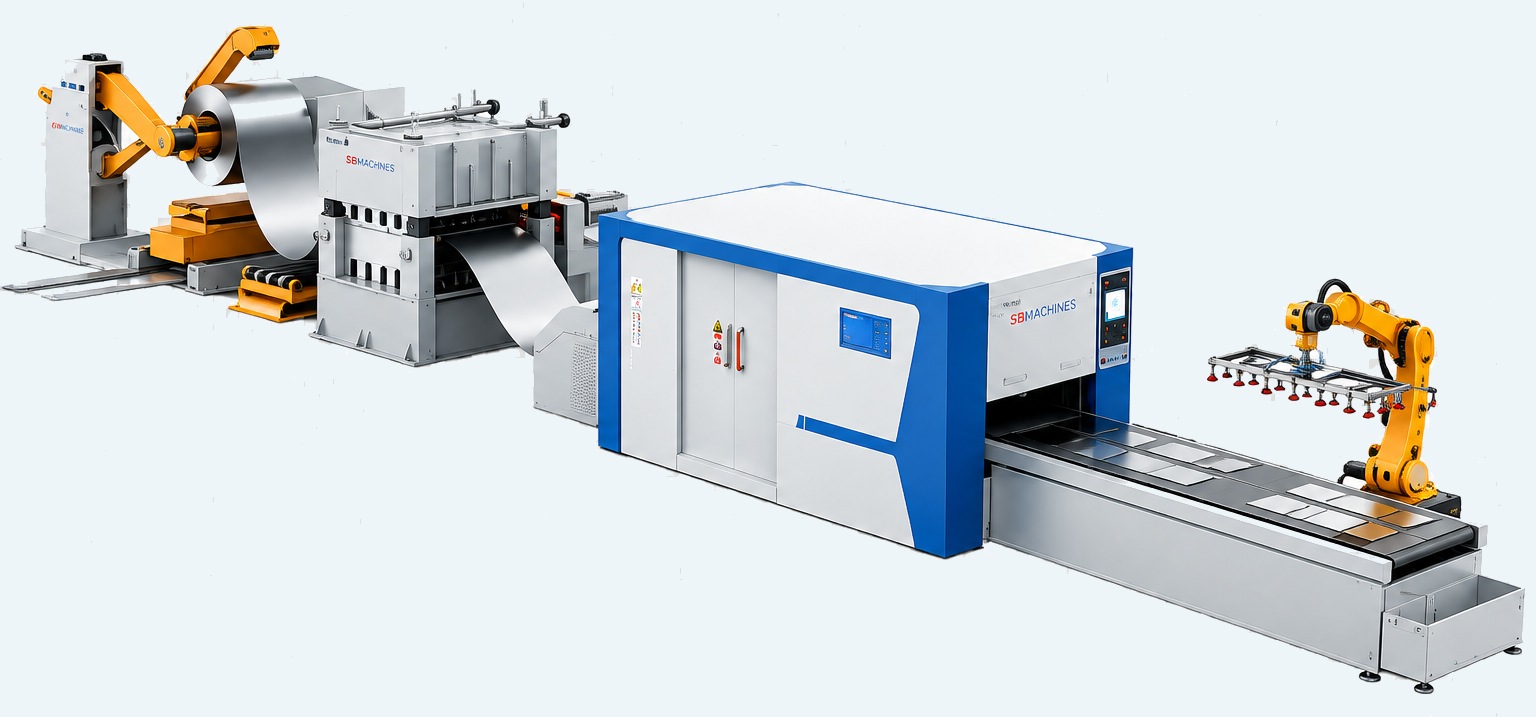
An SU3E coil-fed line is already in Germany.
A complete line — uncoiler, leveller, laser cutting and robotic sorting. We are showing it at EuroBLECH in Hannover, so you can judge the machine in person instead of from a datasheet.
- Single cutting head
- 3 kW fiber laser
- Coil width up to 1,250 mm
- Material 0.6–1.5 mm
- Cutting table 1,250 × 3,000 mm
- 6-axis robotic sorting
EuroBLECH · 28th International Sheet Metal Working Technology Exhibition · Hannover Exhibition Grounds · 20–23 October 2026 · Hall 15, booth C06
Why Choose Coil-Fed Laser Cutting?
Outperform mechanical blanking and table lasers with unmatched flexibility and efficiency.

Material Efficiency
Tight nesting and continuous coil feed reduce scrap by 15–20% vs sheet-fed systems.

Space Saving
Coils require up to 80% less warehouse space compared to equivalent sheet stock.

Die-Free Production
Save on costly dies, maintenance, and storage with software-driven cutting.

High-Speed Cutting
Laser head speeds up to 130 m/min with 1.2g acceleration for faster production.

Automation
Fully automated from coil to finished part, reducing labor and errors.

Scalable Production
Easily adjust production volumes without retooling — ideal for both small batches and high-volume runs.
Industries and Applications
One coil-fed laser line cuts part families for many sectors.
- Automotive: body and structural blanks, EV battery tray and cover blanks
- HVAC and climate equipment: housings, heat exchanger parts, enclosures
- Home appliances: panels and housings from galvanized and pre-painted steel
- Cookware: discs of any diameter from stainless steel and aluminum
- Knives and cutlery: blade blanks in several thicknesses
- Commercial refrigeration: chamber panels, display cases
- Silos and steel tanks: roof segments, wall sheets
- Agricultural machinery: panels, guards, hoppers
- Solar and energy: frames and mounting parts
- Heavy transport: wheel discs and frame elements up to 20 mm
- Contract manufacturing: many customers and part numbers on one line
Materials, thicknesses and line components by industry: How a coil-fed laser line works.
Ready to Boost Your Production Efficiency?
Leave a request and we'll calculate how much you can save with our coil-fed laser solutions.
Coil Laser Series Compared: SU3E, SU3Pro, SU4, SU5
Key parameters of the four series. The values are series ranges; exact figures depend on the configuration and are fixed in the quotation.
| Parameter | SU3E | SU3Pro | SU4 | SU5 |
|---|---|---|---|---|
| Best for | Thin metal up to 1.2 mm; the most compact line | Coil and sheet cutting, including long blanks | Multi-head cutting, optional part sorting | Underside surface protection, belt unloading |
| Coil and material | ||||
| Strip width | up to 1,500 mm | up to 2,150 mm | 300–2,150 mm | 300–2,100 mm |
| Strip thickness | 0.6–1.2 mm | 0.6–20 mm | 0.6–20 mm | 0.6–3 mm |
| Decoiler capacity (coil weight) | 10–15 t | 10–35 t | 10–35 t | 10–30 t |
| Laser | ||||
| Laser power | 1.5–6 kW | 3–60 kW | 3–30 kW | 3–12 kW |
| Laser source and cutting head | Lasers: MAX, Raycus, IPG. Cutting heads: Raytools, Precitec. | |||
| Cutting heads | 1 cutting head on 1 gantry as standard; up to 8 gantries optional | |||
| Cutting | ||||
| Standard cutting zone | 1,500 × 3,000 mm | |||
| Larger zones (examples) | On request | 1,600 × 10,000 mm | 2,000 × 9,200 mm and 2,000 × 10,400 mm | On request |
| Strip during cutting | On request | On request | On request | The strip can keep moving while it is cut |
| Positioning / repeatability | On request | ±0.05 / ±0.03 mm | ±0.05 / ±0.03 mm/m | On request |
| Operation | ||||
| Operators | 1–2 (1 for a 1,500 × 3,000 mm line; 2–3 for a 2,000 × 10,400 mm line with robotic unloading) | |||
| Coil change | Up to 5 minutes from placing the coil on the trolley to feeding the strip into the cutting zone | |||
| Unattended running | Until the coil runs out, if robotic unloading is fitted. An operator changes the coil and empties the skeleton recoiler or scrap bin. | |||
| Nesting software | On request | Metalix cncKad: automatic and ultra-long nesting, sorting control; MES integration possible | Metalix cncKad: automatic and ultra-long nesting, sorting control; MES integration possible | On request |
| Remote diagnostics | Yes | |||
| Delivery and warranty | ||||
| Installation and commissioning | From 2 weeks (basic lines) to 1.5 months (large lines with unloading) | |||
| Warranty | 2 years on everything except consumables | |||
| Certification | CE and ISO 9001 (declared by the manufacturer) | |||
| SU3E details | SU3Pro details | SU4 details | SU5 details | |
Standard equipment and options
Included as standard
- Decoiler and loading trolley
- Leveller (selected for the thickness range)
- Strip feeding
- One cutting head on one gantry
- Manual part unloading
Optional
- Feed length control and end-crop shears
- Scrap removal: conveyor, skeleton recoiler, shredder
- Gantry unloading
- Robotic unloading (number of robots chosen per line)
- Restacking robot with machine vision, after the main unloading
- Strip-edge sensors for higher material utilisation
- Marking, 20 / 30 / 50 W
- Additional cutting gantries (up to 8) and marking gantries
Combined lines are possible on request: a coil laser with a panel bender, with a stamping die, or with punching.
Main component manufacturers
CNC: Beckhoff. Cutting servo drives: Yaskawa. Chillers: Tongfei. Electrical components: Schneider. Rack and pinion: YYC. Linear guides: HIWIN. Pneumatics: SMC and AIRTECH.
Is a Coil Line Worth It for Your Production?
Whether a coil line pays back depends on three figures:
- annual metal tonnage;
- actual material utilisation with your current sheet-based process;
- the difference between the purchase price of sheet and of coil.
Then take your real part range and run two nestings: one on sheet, one on coil. This comparison shows the real economic potential of the project and is more reliable than any averaged figure.
A coil line is not always the answer. With low annual tonnage, with high utilisation already reached on sheet, or with little or no price difference between sheet and coil, the saving may not cover the investment. The calculation shows this before you commit.
Send us your part list and we will run both nestings: use the request form at the bottom of this page.
Coil-fed laser cutting: questions and answers
What is a coil-fed laser cutting machine?
A coil-fed laser line unwinds a metal coil, levels the strip, feeds it into the laser cutting zone and unloads the finished parts. It cuts parts directly from the coil and needs no dies. Nesting software lays the parts out along the strip, so utilisation is higher than on a sheet.
What strip width and thickness can SBMachines coil lasers cut?
SU3Pro and SU4 take strip up to 2,150 mm wide and 0.6–20 mm thick. SU5 takes strip up to 2,100 mm and 0.6–3 mm, SU3E up to 1,500 mm and 0.6–1.2 mm. The exact limits depend on the material and the laser power.
How many operators does a coil line need?
One to two. A 1,500 × 3,000 mm line needs one. A 2,000 × 10,400 mm line with robotic unloading needs two to three: one at the control panel, the others watch feeding, cutting and unloading.
Can a coil line run without an operator?
Until the coil runs out, if robotic unloading is fitted. An operator changes the coil, which takes up to 5 minutes, and empties the skeleton recoiler or scrap bin.
How long do installation and commissioning take?
From 2 weeks for basic lines to 1.5 months for large lines with unloading. The time depends on the configuration and the options.
What warranty and certification do the lines have?
The warranty is 2 years on everything except consumables. The manufacturer declares CE and ISO 9001.
Can a coil laser be combined with a bender, a stamping die or punching?
On request. Lines with a coil laser and a panel bender exist, a laser can be combined with a stamping die, and lines with a coil laser and punching exist.
Comparative Table: Coil-Fed Laser vs. Sheet-Fed Laser vs. Press Line
- Stamping press is faster in mass production, but requires huge tooling costs, not flexible and unprofitable for small series.
- Coil-fed laser is the golden mean: high speed, material savings, flexibility, no stamping costs.
- Sheet-fed laser is a traditional but less efficient solution compared to coil-fed laser.
| Parameter | Coil-Fed Laser | Sheet Laser | Stamping Press |
|---|---|---|---|
| 10% Material Cost Economy | ✓ | ✓ | ✗ |
| $0 Tooling Cost | ✓ | ✓ | ✗ |
| Production Flexibility | ✓ | ✓ | ✗ |
| Changeover Time in Seconds | ✓ | ✓ | ✗ |
| Minimum Warehouse Space Usage | ✓ | ✗ | ✗ |
| 1–2 Operators per Line | ✓ | ✗ | ✗ |
| 3-sec Cycle Time per Part | ✓ | ✗ | ✗ |
| Minimum Batch Size | ✓ | ✓ | ✗ |
| Payback Period Less than 1 Year | ✓ | ✗ | ✗ |
| Medium Maintenance Complexity | ✓ | ✓ | ✗ |
| Learn More |
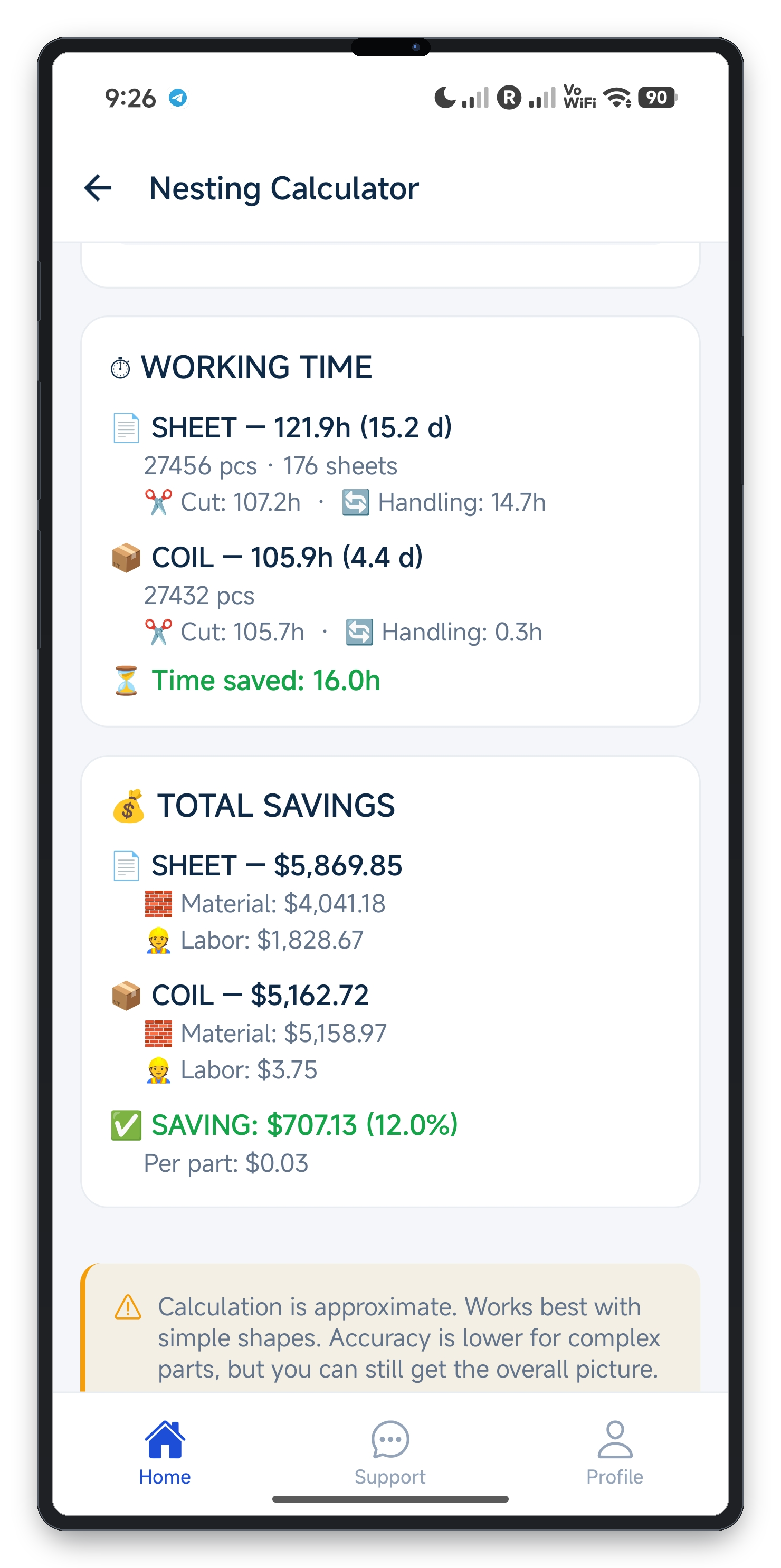
See Your Real Savings: Coil vs. Sheet vs. Press
SBM Laser Help puts a real economic comparison in your pocket. Enter your part and material, and see exactly how coil-fed laser stacks up against sheet-fed cutting or a stamping press.
- Compare cutting time and cycle time between coil, sheet and press
- See exact material and labor cost savings before you switch
- Free for every fiber laser shop — no card required
Upload your DXF drawing → get coil vs. sheet vs. press savings instantly
#1 app for laser cutting operatorsTrusted by thousands of shops worldwide
Coil-Fed Laser in Action
From Coil to Finished Part in One Seamless Process
Discover how our system transforms raw coils into high-precision blanks.

1. Uncoiling
The uncoiler feeds metal coils smoothly into the system.

2. Leveling
Removes coil defects for flat, stress-free material.

3. Laser Cutting
Precision fiber laser module cuts blanks with tight tolerances.

4. Part Handling
Automated systems separate parts from scrap and stack them.

5. Control System
Advanced automation ensures efficiency and accuracy.

6. Stacking & Output
Finished blanks are automatically sorted and stacked, ready for immediate transfer to the press or forming line.
Main Components of a Coil-Fed Laser Machine
A coil-fed laser machine is a complex yet perfectly balanced system, consisting of the following key components:
01
Decoiler
A device for unrolling the metal coil, ensuring a smooth and controlled feed of the material.
02
Straightener and Feeder Rolls
A system that straightens the metal strip and precisely feeds it into the cutting area.
03
Laser Source
The heart of the machine, generating a powerful laser beam (typically a fiber laser for metal processing).
04
Laser Cutting Head
Automatically adjusts gas parameters to ensure high cutting quality.
05
CNC Control System
A computer control system that interprets CAD models and governs the movement of the cutting head, ensuring precision and repeatability.
06
Conveyor System
The surface where the cutting takes place. In coil-fed systems, a conveyor belt or roller system is often used for continuous material feeding.
07
Automatic Scrap Removal System
Removes material scraps and harmful fumes generated during the cutting process, ensuring a safe and clean working environment.
08
Parts Collection System & Stacking System
Automatically collects finished parts and stacks them or places them into containers.
Detailed Technology Comparison
See how coil-fed laser cutting stacks up against traditional press lines and sheet laser cutting across every key parameter.
| Feature | Traditional Press Line | Sheet Laser Cutting | Coil-Fed Laser Cutting |
|---|---|---|---|
| Flexibility | Fixed shapes only (dies required) | High — flexible cutting of sheets | Maximum — continuous flexible cutting from coil |
| Tooling Cost | High — dies must be designed, built, and maintained | No tooling required | No tooling required |
| Changeover Time | Long — tooling replacement required | Short — program switch | Instant — program switch, continuous feed |
| Material Waste | Higher — rigid layout, more scrap | 10–15% higher than coil-fed: sheet edges are lost, dividing strips required between parts | Lowest — optimized nesting + coil material |
| Automation | Partial — needs operator handling | Moderate — with loading systems | Full — uncoiling, leveling, cutting, stacking |
| Maintenance | Frequent — mechanical wear of dies | Low — optical and mechanical parts | Very low — few moving parts, integrated |
| Footprint | Large — multiple machines and stations | Medium — one station + loader | Compact — inline system |
| Material Compatibility | One die per material type | Universal — steel, aluminum, etc. | Universal — works from coil in all materials |
| Design Change Speed | Weeks (new die needed) | Minutes — load new CAD file | Instant — CAD-driven, continuous |
| Economic Efficiency | Effective only for large volumes | Efficient for small to medium batches | Highest efficiency + material savings |
| Real Savings Example | — | — | One client saved over $290,000/year on material |
Customize Your Coil-Fed Laser System
Enhance your production with advanced options tailored to your needs.

Gantry System for Part Collection
An automated gantry system sorts and stacks laser-cut blanks, accelerating production and reducing manual labor.

6-Axis Robot for Stacking
A 6-axis stacking robot automates the precise stacking of cut parts, handling various shapes and sizes. It reduces labor costs and increases efficiency.

Multi-Gantry Laser Cutting System
Upgrade your machine with a multi-gantry cutting system to boost production speed by 2x, 3x, or even 4x.

Integrated Panel Bending System
This integrated bending system automatically processes parts after laser cutting, ensuring high precision even for complex shapes. It minimizes manual handling and speeds up production.

Additional Uncoiling System
Multiple uncoilers allow processing of different material thicknesses without reloading. More automation means less downtime and higher efficiency.

Filtration and Ventilation Unit
The filtration and ventilation system removes dust and smoke generated during laser cutting. Equipped with a Siemens motor and a Japanese TORAY filter.

Additional Air Compressor
Screw-type air compressor designed for laser cutting. Ready-to-use system includes dryer, oil separator, and air filters.

Laser Marking System
High-speed laser marking system for accurate part identification. Power options: 20/30/50 W, marking speed up to 8000 mm/s, marking area 100×100 to 300×300 mm. Multilingual interface.
Our Clients Love Us
Ready to Boost Your Production Efficiency?
Leave a request and we'll calculate how much you can save with our coil-fed laser solutions.


SU3E Series – Entry Level Coil Lasers
- Laser power: 1.5–6 kW
- Coil width: up to 1,500 mm
- Coil thickness: 0.6–1.2 mm


SU3Pro Series – Professional Automated Coil Lasers
- Laser power: 3–60 kW
- Coil width: up to 2,150 mm
- Coil thickness: 0.6–20 mm


SU4 Series – Multi-Head Coil Lasers
- Laser power: 3–30 kW
- Coil width: 300–2,150 mm
- Coil thickness: 0.6–20 mm


SU5 Series – Zero-Waste Coil Lasers
- Laser power: 3–12 kW
- Coil width: 300–2,100 mm
- Coil thickness: 0.6–3 mm